Wednesday, April 1, 2015

FORTUNE COOKIE FORTUNES


Fortune Cookie Fortunes

Written and Illustrated by Grace Lin
Published by Dragonfly Books
Copyright 2006
Multicultural Fiction Book
32 Pages

 The older our students get, the more they will be exposed to a diverse society, so it is important that we expose them to a variety of cultures. I chose this book for that very reason. Grace Lin write about fortune cookies which we most commonly associate with Chinese heritage. In this story, a young girl doubts the truth behind the traditional fortune hidden inside the cookie. She observes her family and friends making connections throughout the day. Does her fortune come true?


The author of Fortune Cookie Fortunes also illustrated this children's literature book. Each page is filled with vibrant colors and hand drawn art work. The medium used throughout this story is watercolor which brings the images to life. Grace Lin does use space and perspective on each page. The person which the text is focusing on appears larger than the others to emphasize the importance of what they are saying or doing. 

The author recommends using this text for grades k-3. There are many activities which could be used for this work. One which I would consider doing is giving the students each a fortune cookie. Have them all open their cookie (they may eat it if they like) and save the fortune inside. This will be used as a prompt for writing a narrative story of a grade level length. Another activity which could be manipulated for use in this story is a cause and effect flow chart. The students will write about the effects of the families choice to eat at the Chinese restaurant and opening a fortune cookie. Each family member had a different outcome which would be the effect of reading their fortune cookie. One final activity which I would suggest using with the book, Fortune Cookie Fortunes, is making a classroom prediction wall. Each child could write a well-thought out prediction of the main idea of the story on a sticky note. These will then be posted on the board anonymously. After the read aloud, the students will see if their predictions were correct or not as they engage in a discussion on the author's purpose of writing this story. 

Thursday, March 26, 2015

BACK OF THE BUS


by Aaron Reynolds
Illustrated by Floyd Cooper
Publish by Puffin Books
December 2013
32 Pages
Realistic Fiction


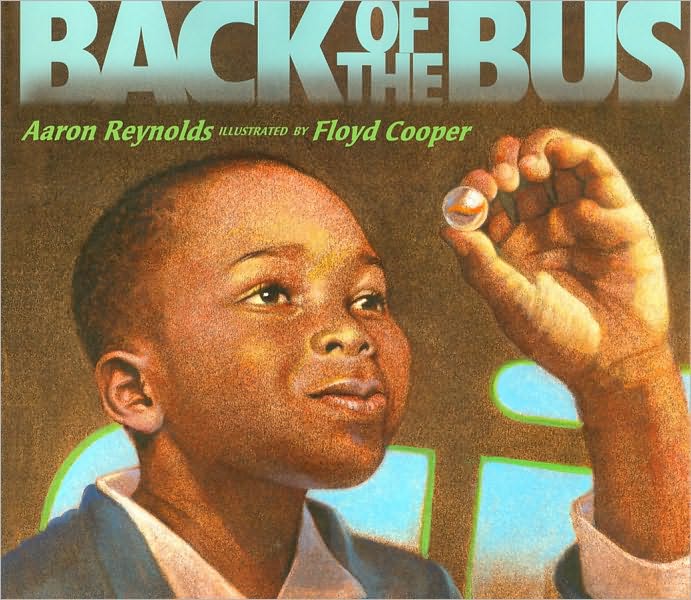
While looking up titles for recommended children's literature books for black history month, I stumbled across this gem. This book is a fantastic read with a guest appearance by a very famous black woman in history who stood her ground. This book is told in first person from the young boys point of view. So much occurs on his short little bus ride with his mother. After reading this story, you will be able to put the pieces together and quickly figure who the mystery woman is. I enjoyed this book because you got to see the impact she made on this child which will likely change his life forever. 


The Coretta Scott King medalist, Cooper Floyd has done a marvelous job with the illustrations in this story. The pictures are hand painted and so very detailed. You could actually just look at the spread on each page and know exactly what is happening in the text. Mr. Floyd does use space and perspective in his images to stress that the story is being told from the young boys point of view. This is essential in showing how this historical event affected those surrounding the mystery woman on the bus. 


I would highly recommend this book for grades 1-3. This would be a great story for a read aloud or individual study. As the teacher, I would be sure to question the students before, during, and after completing this picture book. He or she should ask questions which require higher order thinking. The teacher should also have the students make predictions about the story in a journal then compare their thoughts after the read aloud. Another possible activity to complete with Back of the Bus is to write a narrative about the mystery woman. The students should share who she is and how her actions have made an impact in American history. 

Wednesday, March 25, 2015

HOW MY PARENTS LEARNED TO EAT


by Ina R. Friedman
Illustrated by Allen Say
Published by Houghton Mifflin Harcourt
Copyright 1984
32 Pages
Realistic Fiction (Multicultural)

When you see a couple comprised of different cultural backgrounds you never really think about the obstacles they had to overcome. This story is being told by a multicultural families daughter. She shares with us that her mother was a "Japanese School Girl", and her father was an "American Sailor" when they first met.  This new couples greatest dilemma was dinner. Neither was comfortable eating with the other because of the cultural differences. The two actually avoided going on a date for this very reason. We obviously know that they settle their differences since they do have a daughter together, but how did they manage? Will the American Sailor learn to eat with chopsticks? Will the Japanese School Girl learn to eat with a knife and fork? 


Allen Say, the illustrator, drew his images with pencils then added color with paint. The pictures are very detailed in their two dimensional format. In the image above, you can see that the illustrator uses space and perspective. The young daughter who is telling the story can be found in the top left corner. As I look at this page, I visualize a little thought bubble coming out from her head containing this image of her mother and father who are the main characters of the story. 

There are so many activities for this book which would be suitable for ages 5-8. The children would really enjoy learning to eat with chopsticks much like the father had to do. The teacher could provide a mini lesson/tutorial on how to use chopsticks then let the students try them out at lunch. The students could also complete a compare and contrast chart. The book list many differences of the two cultures aside from their eating habits. One last activity which the students would greatly benefit from would be to write their own narrative. They could share how their family eats at home and the types of food which they prefer. This would be a great opportunity to allow the diverse students express their cultural backgrounds in comparison to their fellow classmates. 

Tuesday, March 24, 2015

REMEMBERING THE TITANIC


Remembering the Titanic

by Frieda Wishinsky
Multiple Illustrators
Published by Scholastic Inc. 2012
31 Pages
Informational Book


One of history's most well-known voyages across the ocean is the Titanic. The unsinkable, floating palace set sail on April 10th, 1912 from Southampton, England to New York City. This ship weighed in at 52,310 tons, had nine decks, and was larger than a fifteen-story building. You can only imagine the excitement of the passengers who were privileged enough to travel on her first voyage. For most people, this was their only hope at starting over and living the life they had always dreamed of. Unfortunately, this dream did not come true for nearly 1,500 of the passengers on board, and the rest are scarred for life with the horrible memories.


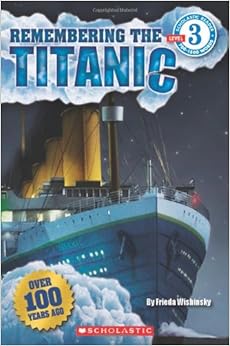
There is a team of people whom contributed to the illustrations in Remembering the Titanic. The majority of the book consists of real photos which were hand selected, by the group of illustrators, of the "Unsinkable Ship". Some of the pictures were from the original voyage and others are from the box office hit Titanic, the movie. On page 18, the team of illustrators did include a painting which captured the horrific scene of people fighting for their life as they drifted away in the life boats. The images really add a lot of emotion to the text. They allow the reader to visualize each moment as the "Floating Palace" split in two and sank to the bottom of the ocean.


The back of this informational text contains a lot of useful information for educators. The book has been labeled appropriate for first to third grade reading levels and consists of 700-1500 words. The growing readers would greatly benefit from studying the text features throughout this work. The teacher could model the purpose of each feature and show how it contributes to the text. The teacher may also consider having a mini lesson on how to properly use the glossary found in the back of the book. Students tend to over look this beneficial resource. One final activity teachers may be interested in using  Remembering the Titanic for would be a KWL chart. This would be the perfect way to ensure that students are engaged before, during, and after the read aloud. 

Sunday, March 22, 2015

WHO WAS HELEN KELLER?


Who Was Helen Keller?

by Gare Thompson
Illustrated by Nancy Harrison
Published by Grosset & Dunlap
Copyright 2003
105 Pages
A Biography


I really enjoy reading about my home state, Alabama. Many interesting, historical events have occurred in this beautiful southern state. Alabama is also known for a number of people who have greatly impacted society, one of which is Helen Keller. She was born in the year 1880 in Tuscumbia, Alabama. Helen was an intelligent child whom succeeded on many levels. At age 2 she became extremely ill with a fever. Her family had no idea if their golden child was going to be able to pull through such a horrible illness. Well, Helen overcame the odds and beat the fever. Little did she know that she won the battle, but a much greater war was in her near future. 


Who Was Helen Keller? is a chapter book, therefore it has very few illustrations. The illustrator, Nancy Harrison, did do a fabulous job creating the cover photo. If you look at the colorful, hand drawn image above you can see that she made Helen's head very large. I think this was intentional to symbolize all of the intelligence that she had. Now the pictures inside the book are also hand drawn with pencils and/or ink. They are not in color like the front cover, but they do aid the text. The images highlight the main idea of each page. 


This biography would be ideal for a unit study about woman in history. One week the class could focus on Helen Keller. The teacher could read this chapter book to her students over the course of week. One activity that would work great with this story would be the study of sign language. The teacher could model basic words or the alphabet to the class as they try to communicate with one another using the new language. The teacher could also introduce the class to a variety of assistive  technology for students who are blind and deaf. I would be sure to include such things as braille and recording devices. Another activity the class may be interested in is creating a timeline which follows Helen Keller's 88 years of life. The students could work together to note all of the influential people which she met and worked with. The teacher could also be sure that the class includes her accomplishments over the years, and the books which she wrote. There is a timeline in the back of the book that the educator could use as a guideline. I do believe that this book is an easy read. I would suggest using this in an elementary classroom for grades 2-6. The complexity level of the work required can be manipulated for each of these grades. 


Tuesday, March 10, 2015

THE WIZARD OF OZ


Retold by Claire SipiIllustrated by Holly Clifton-BrownPublished by ParragonCopyright 2014Modern Fantasy


The bright and colorful illustrations on the book cover really grabbed my attention. I knew that if I found the book irresistible, that my students may do the same. I do consider this story to be a modern fantasy because it provides an escape from reality by bringing life to inanimate objects. The animals are also given human like characteristics. The events which occur in this story are far from realistic. The book follows Dorothy and her new found friends along the yellow brick road. Each of the travelers are in search of something which they believe they need to find happiness. Once reaching their destination, they are all shocked to discover the solution to their problems. What do you think happened?

The illustrator, Holly Clifton-Brown, uses watercolors and pencil drawings to assist the text of this story. The reader can really relate to how the characters are feeling just by analyzing their facial expressions within her illustrations. The emotions and feelings of the characters are greatly exaggerated with Mrs. Brown's expressionistic style of work. She also uses perspective and light by reflecting a different point of view in certain images. Each time a new character is introduced in the story, the illustrator creates the drawing/painting from his or her perspective. The new character appears to be very large with the others standing in the background. Naturally, the reader's attention is drawn to the new character and the reactions of the others.


The Wizard of Oz is not an extremely lengthy story, but the pages do contain a lot of text. With that being said, I would suggest this book for a read aloud lesson in the second and third grade classrooms. The progressive plot in this book would make for a great lesson. The students could actively participate in creating a time line as well as identifying the beginning, middle, end, problem, and solution. The educator could also use this book to introduce a literary term such as moral. The class may work together to develop their own ideas as to what the author wanted to teach them by writing this story. The children should be encouraged to use creativity in their attempt to identify details which support their hypothesis for the moral of the story.